This CD has been in my review box for far too long. Better late than never! Dust is the sixth recording from this Celtic fusion band. I really enjoyed their first release, Mellowosity (1996). I don’t recall hearing the four CDs between that one and this. A more recent outing, Blackhouse, was released earlier this year (2015).
The concept of Celtic fusion has a few different meanings. In the case of the Peaties, as they are called, many of their compositions have some Celtic influence. However, the dominant sounds are created by synthesizer and drums (although on some tracks the drum beat like it’s coming from a synthesizer too). The sound is more like dance music with a strong rhythmic beat, rather than like rock music from bands like Black 47 or Dropkick Murphys. The Peaties remind me of some of the New Wave bands I listened to back in the 80s, like Depeche Mode or Tears for Fears but without vocals. This is an instrumental band. I checked out one of their live videos on YouTube. They play well, they are loud, and they are definitely fusion.
Based on the Isle of Skye in Scotland, the Peaties have six members. This line-up has remained consistent since the band’s founding in the early 1990s. On Dust, Peter Morrison plays pipes and whistles, while Peter Tickell handles the fiddle and effects. Tom Salter plays the guitar and Graeme Stafford is featured on keyboards and virtual synthesizer. Innes Hutton covers bass, guitars and bodhran and Stu Halkney holds down drums and percussion. Guest artists appearing on Dust include Rick Taylor on trombone and Nigel Hitchcock on sax, as well as Jarlath Henderson on uillean pipes and Paul Templeman on steel guitar.
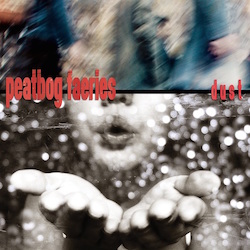 Dust runs just over an hour long and contains eleven tracks, each running roughly four to six minutes in length. The CD is packaged in a paperboard tri-fold case. While there are no separate liner notes, there are very brief notes on each track, including its composer, on the inner folds of the case. Morrison and Tickell are the composing members of the band, although it appears that all the members participate in and contribute to the arrangements.
Some of the tracks, notably “The Naughty Step,” “Abhainn A’Nathair” (The River of Snakes) and “Ascent of Conival,” have that relentless pulsing beat that I equate with rave culture, although I could trace it back to disco without a lot of effort. On these I definitely wondered if the beat came from drums or synthesizer. “The Ascent of Conival” also features very nice sax and flute solos. Even in the midst of the dance beat, a nice little pipe tune wanders through “Abhainn A’Nathair.”
While “Calgary Capers,” “Marx Terrace” and “Spigel and Nongo” seem to put the spacey synthesizer sound up front (sounding more New Age than New Wave), on these three tracks I could hear snippets of melody that sounded like Celtic dance tunes. “Dun Beag” sounds more Celtic than the rest, reminding me of Old Blind Dogs on the Five album. “Passport Panic” has an almost bluesy quality and offers a lovely fiddle solo. “Fishing at Orbost” is also fairly down tempo — I might describe it as a slow air if I were using the language of traditional music.
If I were still hosting free form dance parties, as I did back in the 80s, I would consider adding some tracks from Dust to my mix. I don’t think, though, that I will be using anything from this CD for my yoga classes!
(Peatbog Faeries, 2011}
[Editor’s Note: The Peatbog Faeries have a website and are on Twitter @peatbogfaeries. The Green Man Review previously reviewed their 1996 debut album Mellowosity, their third album 2003’s Welcome to Dun Vegas, and the self-released 2009 Live.]


Leave a Reply